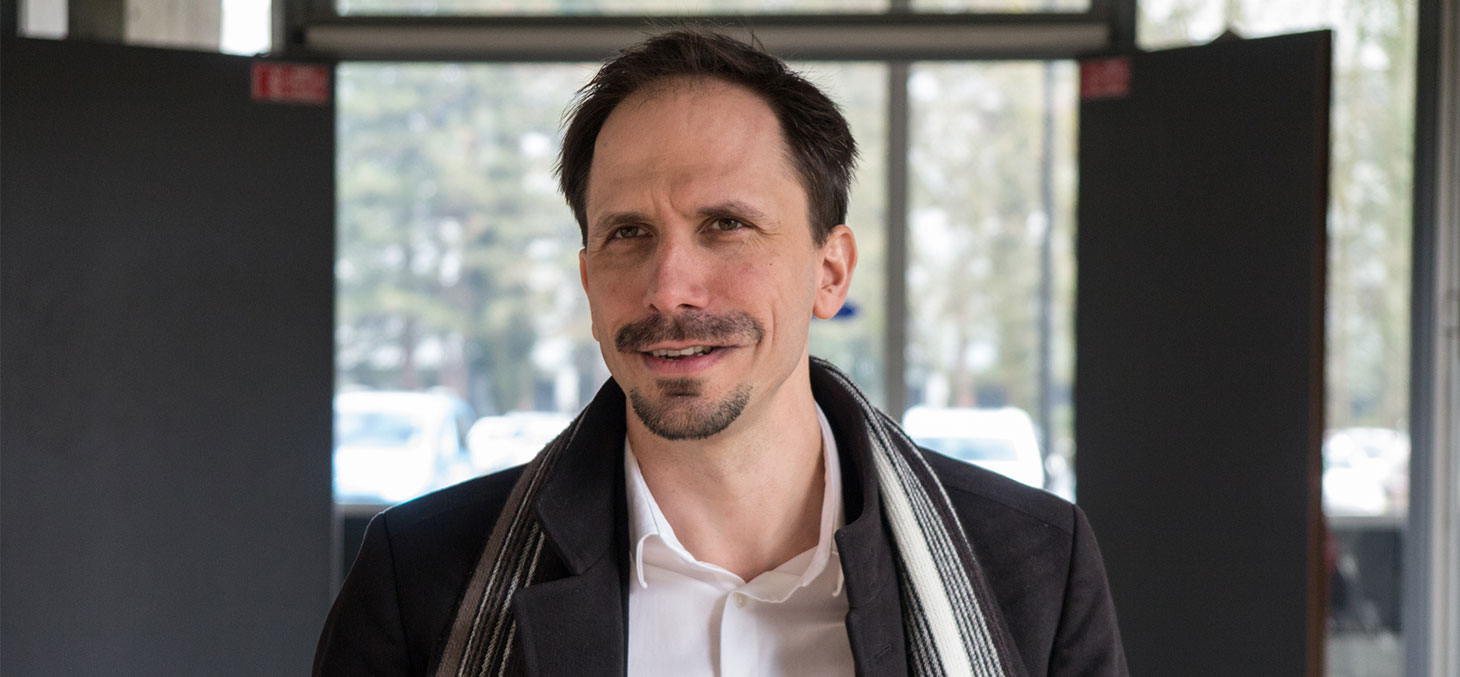
A theater and film fan, this modern history teacher atUniversité Grenoble Alpes tries to teach his students differently. While he doesn't disavow traditional lectures, he's keen to help his students appropriate knowledge in a new way.
knowledge in a new way.
December 2017. Gilles Montègre and thirty of his students take line 11 of the Paris metro. Right in the heart of the capital, the little Grenoble troupe gets off at the Arts et Métiers station to go to the eponymous museum. Here, no white tiles, as is customary in Paris: the metro walls are clad in copper, and large cogwheels emerge from the ceiling. Designed by François Schuitten (comic strip artist and scenographer), the station puts students in the picture.
From the inverted classroom to the hybrid classroom
"It's got a bit of a steampunk, retro-futuristic feel to it, and it's a great theater for arriving in Paris."smiles historian Gilles Montègre. The teacher organized the trip with a view to a special visit to the Musée des Arts et Métiers. His students took a course in the history of science and knowledge between the Renaissance and the Enlightenment, in Grenoble. So, once inside the walls, each of the students will experiment with the inverted classroom: the students must produce a presentation based on the machines conserved at the museum. These include Vaucanson's automata, Lavoisier's laboratory and Cugnot's fardier (also known as the "chariot à feu", the very first automobile in history). Gilles Montègre explains the aim of the project: "At university, knowledge is essentially approached in two dimensions through texts. In a museum such as Arts et Métiers, students have to consider their knowledge in three dimensions, to explain to their fellow students how these machines actually worked".
This inverted classroom was also prepared by following an online course, born of a partnership between Cnam and Promisingand shot in the Museum's rooms. Gilles Garel and Loïc Petitgirard are the designers of this MOOC entitled Manufacturing innovationThe Grenoble students have followed a number of the videos integrated into their digital workspace, in particular those devoted to the history of the steam engine. "When they arrive in Paris, these Grenoble students are immediately placed in an active position with regard to the knowledge that the Museum mobilizes".says the teacher.
The story of travel and poaching
If he considers travel to be formative, Gilles Montègre has his reasons. In order to become a teacher-researcher, he worked on his thesis entitled "La Rome des Français au temps des Lumières" between Grenoble, Paris and Rome, spending 6 months a year poring over manuscripts in the Italian capital's fantastic libraries. More recently, the historian edited the first volume of a major travelogue: that of 18th-century naturalist Latapie.
"It turns out that this beautiful account had never been published before. It is also the most complete travel diary of all those devoted by the French to Italy in the Age of Enlightenment. For this critical edition. We had to transcribe the manuscript preserved in private archives, add over 1,700 annotations, and produce an introductory study analyzing the originality of this traveler in the historical context of the Grand Tour. a journey of aristocratic education based essentially on the discovery of Greek and Latin civilizations [Editor's note].".
This travel diary proves to be particularly creative and atypical. "Latapie travels in a spirit of discovery, not just cultural consumption. This is dear to my heart. I believe that individuals at different periods in history have been able to benefit from margins of creativity, even within highly coercive societies."he assures us, evoking the notion of "poaching" dear to the historian, philosopher and Jesuit Michel de Certeau.
In the manner of Latapie wandering through Italy on foot - a far cry from the classic aristocratic journeys accomplished by carriage - Gilles Montègre associates this "poaching" with the activity of individuals meandering through the meshes of imposed institutional networks, collecting fragments of knowledge to nourish and enrich their daily lives. By "poaching" in this way, these individuals demonstrate their personal creativity. Is this a parallel with his career as a university teacher experimenting with creativity? It certainly does.
The Galileo trial revisited through creativity
Today, in fact, creativity has largely crept into Gilles Montègre's courses. His most recent experience dates back to October 2017. "This time I had a precise theoretical idea: to succeed in reconstructing Galileo's trial using creative techniques." Divided into three groups - Galileo's defenders, opponents and judges from the tribunal of the Holy Roman Inquisition - the students spent two hours talking to each other to select the best arguments. "Together with the students, we applied the divergence and convergence processes with which I had become familiar thanks to the Promising training courses."
Then, the next day, the trial took place. "It made me break out in a cold sweat. Not least because of the great mystery of how my students would react. But once we had imagined the installation of all the participants in the trial in the Hive room, and thanks to the investment of the students who really played the game, the result was very encouraging".recalls the history teacher.
If the idea wasn't to re-enact the historic event as closely as possible, "the re-enactment provided the students with new information, but above all enabled them to connect cultural, religious and scientific arguments".he says. "Amazing apparitions have thus taken place, such as that of Saint Thomas Aquinas, who came from the Middle Ages to explain why heliocentrism is dangerous.". The outcome itself was not without surprise, since it was Galileo's opponents who emerged victorious from the trial.
------------------------ Article written by Charles Vonnils
Published July 9, 2018
Updated September 17, 2018
Contact
Gilles Montègre, Deputy Director of the History Department, Senior Lecturer in Modern History UFRARSH
Share linkCopyCopyClose modal windowShare this page URLI recommend this page:Available at this address :The page will then be accessible from your "My favorites" menu.Stop videoPlay videoMute soundPlay soundChat: Got a question?Chatbot Robo FabricaMatomo visitor statisticsX (formerly Twitter)

 Arts and humanities